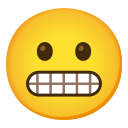
😬 shows a mouth pulled wide with the teeth pressed together. In English it is the “yikes” or “eek” face, and in practice it expresses an awkward wince more than a grimace of pain. It was added in Unicode 6.1 in 2012. It looks like a smile, but it is the smile of someone who has just realised they’ve made a mistake.
How it’s used
- Right after a blunder: “Just replied-all to the whole company 😬”
- Awkward encounters: “Ran into my ex at the party 😬”
- Asking for something uncomfortable: “Any chance you could pay me back this week? 😬”
- Nerves: “Interview in five minutes 😬”
- Softening bad news: “The quote came back a bit high 😬”
😅 (grinning face with sweat) laughs the awkwardness off, while 😬 stays frozen in it. 😁 (beaming face) is real joy, so the two shouldn’t be confused. And 😖 (confounded face) is actual distress, which is a step beyond.
Korea, Japan and the English-speaking world
English speakers lean on 😬 more than almost anyone: “yikes,” “awkward,” “cringe” and “oof.” It is a hedge that lets you say something unwelcome gently, such as “That meeting went… not great 😬” or “Bold choice of outfit 😬.” Because it signals sympathy and a little distance, it’s popular for reacting to other people’s mishaps, too: “Oof, that’s rough 😬.”
Korean has its own text version of the nervous sweat: ㅎㅎ;; and ^^;. When Koreans want to soften a request or a refusal, they often reach for 😅 or ㅠㅠ first, and 😬 reads as a more raw kind of awkwardness. It’s understood, just less common than in English.
In Japanese the name is しかめ面, “a frowning face,” though in use it matches 「気まずい」 (“this is awkward”), 「あちゃー」 or 「うわぁ」. The bared teeth can also look like the childish 「いーっ」 gesture of showing your teeth to tease, so depending on the setting the face might read as playful provocation instead. (^^;) and 😅 are more common choices in Japan.
Where it gets misread
- Mistaken for 😁. A message about a problem looks cheerful, and the sender comes across as callous.
- With the teeth clenched, some readers take it as gritted-teeth anger.
- In a serious apology it feels flippant, so use words.
- Posted under someone else’s misfortune, it can sound like “glad it wasn’t me.”
Design differences by platform
Apple, Google (Noto), Microsoft Fluent and Samsung each draw a mouth full of visible teeth, but the number of rows, the brow position and the eye shape differ. Raised brows push the look towards fear, while rounder eyes with upturned corners make it look like a forced smile. Where each lands between “yikes” and “grin” varies from one vendor to the next.